Introduction
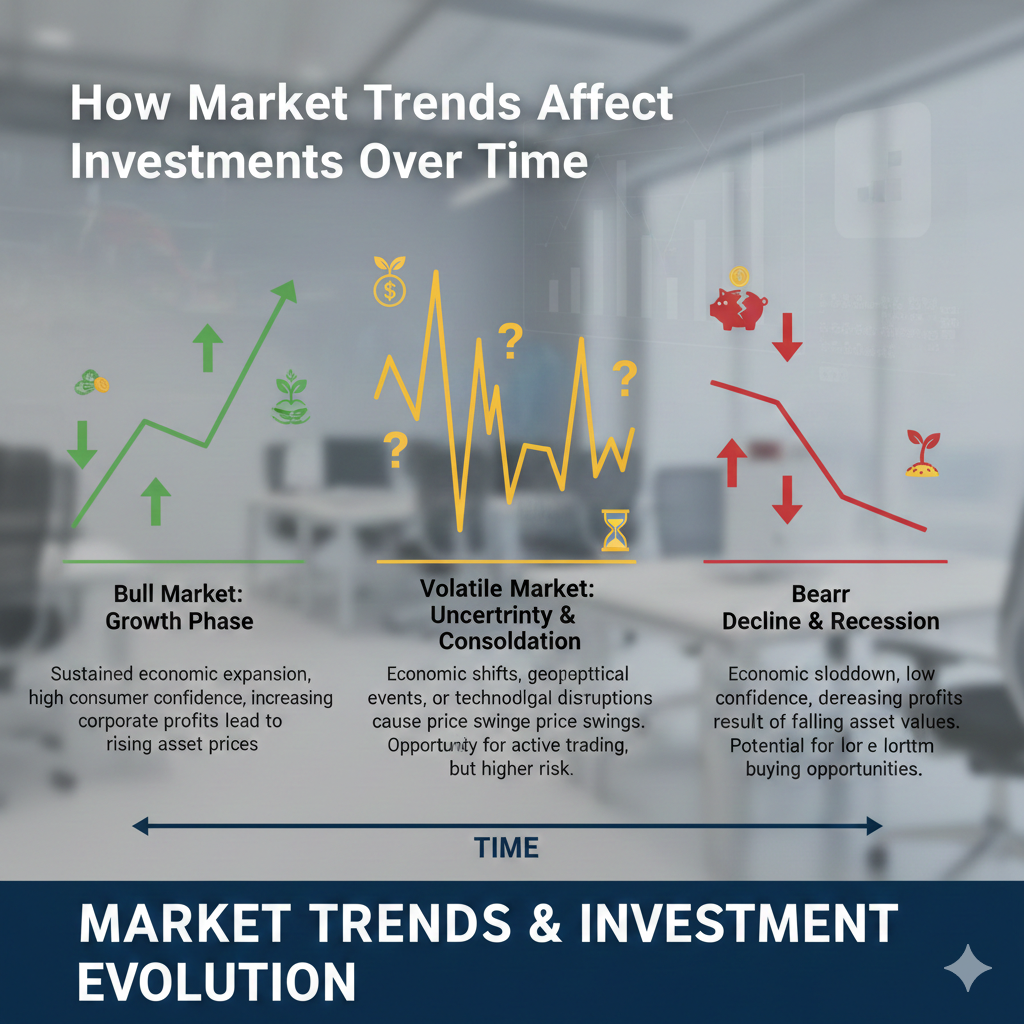
Market trends affect investments by influencing long-term returns, investor behavior, and decision timing rather than just short-term prices. Understanding trends helps investors avoid emotional reactions and align strategies with long-term goals.
When people hear “market trends,” they often think of predictions or quick profit opportunities. In reality, trends quietly shape investment outcomes over years, not days. This article explains how market trends affect investments in practical terms—how trends influence returns, risk, and behavior, and why reacting too quickly to them often hurts more than helps. Instead of forecasting, the focus here is interpretation and long-term thinking.
What Market Trends Actually Are (And What They Are Not)
Market trends describe the general direction and momentum of markets over time. They are not guarantees, forecasts, or signals to act immediately.
From real experience, beginners confuse trends with timing tools. Trends are context, not commands.
Trend vs Prediction
- Trend: Observed direction over time
- Prediction: A guess about the future
[Expert Warning]
Treating trends as predictions leads to rushed decisions and regret.
H2: The Three Ways Market Trends Affect Investments
H3: Return Distribution Over Time
Strong trends often concentrate gains into shorter periods, while long stretches feel flat or disappointing.
H3: Investor Behavior
Trends shape confidence. Rising trends increase risk-taking, while falling trends increase fear.
H3: Capital Allocation Decisions
Investors adjust contributions, risk exposure, and diversification based on trend perception.
From practical situations, behavioral response to trends matters more than the trend itself.
H2: Table — How Different Trends Influence Investor Outcomes
| Market Trend | Common Investor Reaction | Long-Term Impact |
| Strong upward trend | Overconfidence | Increased risk exposure |
| Sideways market | Frustration | Reduced consistency |
| Prolonged downturn | Panic | Missed recovery |
| Recovery phase | Hesitation | Delayed participation |
This pattern repeats across cycles, regardless of market era.
H2: Why Long-Term Trends Matter More Than Short-Term Moves
H3: Short-Term Noise vs Structural Direction
Daily price movement is noise. Long-term trends reflect economic growth, productivity, and innovation.
[Pro-Tip]
If a trend wouldn’t change your plan over five years, it doesn’t deserve action today.
H2: Real-World Scenario — Same Trend, Different Results
Two investors experience the same long-term market trend:
- Investor A continues investing during downturns
- Investor B pauses contributions waiting for “clarity”
Years later, Investor A benefits from compounding. Investor B re-enters later at higher prices.
The trend didn’t change—the response did.
H2: Common Mistakes Investors Make With Market Trends
H3: Chasing Trends Too Late
Fix: Focus on consistency, not entry perfection.
H3: Abandoning Plans During Downtrends
Fix: Separate emotions from long-term strategy.
H3: Overreacting to Headlines
Fix: Evaluate trends on broader timeframes.
[Money-Saving Recommendation]
Avoid changing allocations based solely on news cycles. Headlines amplify emotion, not insight.
H2: Information Gain — Why Trends Feel Obvious Only in Hindsight
Most SERP articles discuss trends as if they were obvious while happening. In reality, trends feel unclear and uncomfortable in real time.
From experience, investors who accept uncertainty during trends tend to make better decisions than those seeking confirmation before acting. The desire for certainty often leads to late entries and early exits.
This psychological delay is rarely explained but critically important.
H2: Beginner Mistake Most People Make With Trends
The biggest mistake is thinking trends remove risk. Even strong trends reverse unexpectedly.
Trends reduce uncertainty slowly—they never eliminate it.
H2: How Investors Should Respond to Market Trends
A practical approach:
- Use trends for context, not timing
- Maintain consistent contributions
- Rebalance periodically, not emotionally
- Increase exposure gradually as confidence grows
(Natural transition: Many investors studying trends also explore market insight tools and long-term planning resources to interpret movements without trading pressure.)
YouTube (Contextual Embed Suggestion)
FAQ (Schema-Ready)
Q1: Do market trends predict future returns?
No. Trends show direction, not certainty.
Q2: Should investors change strategy based on trends?
Only if trends affect long-term goals, not short-term emotions.
Q3: Are trends useful for beginners?
Yes, for context—but not for frequent action.
Q4: Can ignoring trends be harmful?
Ignoring context can increase emotional mistakes.
Q5: How often should investors review trends?
Periodically, not daily.
Conclusion
Market trends influence investments quietly but powerfully. They shape returns, behavior, and confidence over time—not through prediction, but through context. Investors who learn to interpret trends without reacting emotionally are better positioned to benefit from long-term growth. The goal isn’t to follow trends blindly, but to understand them calmly and stay consistent when others hesitate.
Internal Linking Plan
- “long-term investing vs trading” → Category 2 Post 5
- “how risk works in investing” → Category 2 Post 4
External Authority References
- Investopedia — Market trends and cycles
CFA Institute — Market behavior and long-term investing
Internal lik
https://finzenta.com/wp/2026/01/07/bull-and-bear-markets/
External link
https://www.investopedia.com/insights/digging-deeper-bull-and-bear-markets